• One year of Chasing Cetaceans: thoughts and lessons learned

    One year of Chasing Cetaceans: thoughts and lessons learned

    It’s been a hair over a year since I started CC, so it felt like a nice time to write a year in review in September, because why not. 

    First off, if you’re still here a year later, thanks! In transparency, putting myself out there and doing what amounted to meta commentary on a hobby where most commentary is extremely data-driven, pushing a referral link, or both was daunting. I’m glad that (most) of you seem to enjoy reading it.

    The last year has certainly been an interesting one for MSers and churners. We saw explosive, needle-moving plays appear (and reappear, and disappear again). We experienced the final death rattle of both spend avenues and advantageous loop closures. Some of us even experienced some very bizarre asynchronous house calls.  

    Through both writing the blog and being a general participant in the MS community, I learned a lot of things that I think will be helpful to keep in mind going forward. Of course, what’s true for me may not be what’s true for you. But if I was to summarize things that I’d want to keep in mind moving forward, it would be these:

    • I set out being really prescriptive with myself that I didn’t want to talk in too much detail about anything that shouldn’t be on the publicly indexed Internet and that I’d delete anything that someone asked me to, no questions asked. I only got one (very specific) deletion request. After meeting him in person months later and finding out where he lived, it was a funny coincidence where my reference to a personal anecdote lined up with his street MS route, although unrelated.

      That being said, I’ve been doing a lot of self-policing. For example, my first post was about a specific card, and I thought it was ok to call out the card by name since it had a gargantuan marketing budget behind it. But in hindsight, that article wasn’t actually about the card – it was about what you’d use the card for. That doesn’t need to be shared online, and lately I’ve found it more and more necessary to vaguepost about the underlying concept vs. anything that is too specific.
    • The reasons for my vagueposting are various. Shutdowns and plays dying are obviously the big one, but there’s more to it than that. I’ve had more than a few eye-bugging traffic sources show up in my reporting. Whether it’s a blog, or reddit, or Twitter, or App Store reviews, assume that the employees tasked with derailing the free money train are reading what you’re saying, because they are.

      On that subject, we as a community have a serious lack of discretion when it comes to discussing 2026 plays. I understand it to a degree, because couch MS over the last few years was shoved in everyone’s face and encouraged at every level. However, the best plays these days don’t have a table at ChiSem ready for a photo op. It’s not an all you can eat buffet where the facilitator makes money off of you throwing all caution to the wind – you may be affecting your target’s balance sheet. In those brazen days, MS was far from a zero-sum game. But it has certainly inched closer as the last few years have gone on. Think long and hard about what space you’re in before being frank about something you’d hate to lose. 
    • The ability to mentally roll with the punches is so important in the hobby these days. Good things are dying so quickly (in some recent cases, on the same day). They may reappear in a different form, they may not. Will you even have any float because it’s all circulating in that other platform that didn’t exist a few days ago? We’ve all been “fired” by our targets a lot this year, but there’s often a new target that is “hiring”. 
    • That maximizing to the nth degree is usually not the best choice, from top to bottom. As the oft-cited quote goes, “the optimal amount of fraud is zero”. To clarify, that is not a tie-in between MS and fraud, don’t commit fraud. This quote from the article sums it up best: “The marginal return of permitting fraud against you is plausibly greater than zero, and therefore, you should welcome greater than zero fraud.”

      This idea rings true for a lot of MS activities, too. Whether that means making peace with losing some money on liquidation to save lots of time, or, in my current case, taking the L on an exit node not working on vacation and accepting a loss in profit to avoid burning an account, there are many reasons to avoid 100% maximization of profit. 
    • Beneath all the yay free traveling and financial independence rah-rah-rah of the hobby, there’s a dark underbelly to this hobby, in more ways than one. Some things aren’t what they seem, so look out for yourself out there.

    I know that a lot of this sounded pessimistic. Part of that might be the recency bias of losing something good lately. Part of it might just be me being pessimistic. But a lot of this, as always, is just as much a reminder to me as is it anything else. 

    Let’s all cross our fingers that the next year continues to reward churners willing to pivot away from the aforementioned ChiSem method and roll up their sleeves. 

    Baxt!

    Pictured: what MS in 2026 feels like. I need a cigarette


  • On being our community’s Points Guys and Gals

    On being our community’s Points Guys and Gals

    I’ve written a lot about how things change as you progress from shrimp towards whale. Your perception of risk changes. Your perception of scale changes. But it’s not just how you think that changes. It’s what you know, too. 

    Early on, a lot of us allocated all of our brain power to things like historical SUB numbers, organic categories, credit amounts and transfer bonuses. That makes sense as a beginner because all of those topics are the perfect place to work in a never-ending array of affiliate links. 

    As you start to travel and do cool things as a result of this hobby, your friends, family, coworkers, acquaintances, etc. begin to notice and want to know more. It’s only natural as reward cards are a part of the cultural zeitgeist these days.

    At a beginner and intermediate level, you’re in the perfect position to help your loved ones put together a churning plan. After all, the surface level of churning knowledge is fresh in your mind, and you recently walked this path yourself. I used to love helping my friends develop a strategy to maximize their earnings with minimal effort. 

    But as you become more advanced, you spend very little time thinking about the aforementioned topics. The math on a new card is just SUB – fee + credits that don’t involve going to a random Hilton. Even the non-SUB bonused spend gets boring quickly when the vast majority of issuers have learned an uncapped lesson. 

    It’s similar on the redemption side of things. The importance of waiting on transfer bonuses or wading through complicated partner award charts becomes less and less important when your ability to earn wildly outpaces your ability to burn. 

    And as you travel more and become comfortable with being flexible, you may find yourself booking a TT alert on a whim vs. a regimented T-330 approach to ANA J. Hell, you may find yourself booking cash when it makes sense.

    These shifts in thought process aren’t necessarily good or bad – we all have limited mental bandwidth, and a lot of things in this hobby feel purposely convoluted (looking at you, EVA). But as your focus moves from optimization to scale, your ability to answer a simple question like “what card should I get” gets trickier, too.

    I wrote this post because a coworker asked me that exact question. It was easy to answer because she has family abroad and wanted to fly with a particularly promiscuous transfer partner, but it got me thinking about how hard that question is to answer nowadays. 

    What is the best card? I have no idea, because I don’t really pay attention to SUBs even when they’re being shoved in my face. What card allows the best redemptions? I have no idea – I don’t even remember if the T-330 window I referenced above is still the correct window for availability drops, and I’m leaving that (probably inaccurate) note to illustrate my point. 

    I think most of us still do quite well for ourselves while glossing over the breathless proselytizing of a 100k SUB from an issuer that isn’t even exciting anymore. But with that does come some inability to help your crew out with certain things. 

    For example, an advanced churner would answer “what card should I get to pay this $5k bill” very differently than a beginner. You’d also get some head turns for suggesting a card with a $30k SUB or $895 fee. But you’re obviously basing your math off of a different exercise than they are, which is ok. It’s a good thing that not everybody gets sucked in deep, because it’s not for everyone.

    Anyway, for all of the exhausting parts of this hobby, let’s not forget how life changing it can be, even if you aren’t ever entering the deep end. Even the people you know that are least interested in far flung adventures have some sort of leisure that churning will help them accomplish. 

    If you have people asking for advice while you’re deep in the throes of something that will look hieroglyphic to them, you can always open DoC and spend 5 minutes getting the current lay of the land. To kill two birds with one stone, you’d also be able to let them know they can get a free Krispy Kreme donut if they show up wearing Pokemon attire.

    Jerammon!

    Pictured: Some DoCheads who weren’t able to source authentic Pokemon attire and gave up on the free donuts


  • Sunday mini: Serendipity and making your own luck

    I’m currently on a flight home from the (excellent as always) MEAB meetup. It was great to catch up with old friends and meet a lot of new ones, and thanks so much to everyone that had kind things to say about the blog – it really means a lot. I’ll work on an adapted version of my presentation for a post next week.

    Being around a lot of the people that have helped me build to where I am now this weekend got me thinking about the role that serendipity and luck (and making your own luck) can play when it comes to having success in this hobby. 

    While most of your churning and MS spoils are a result of consistent effort, sometimes a happy accident or chance encounter helps nudge things along as well. Much like penicillin, Popsicles, and other things invented as a result of serendipity, sometimes an attempt at doing one thing ends up being fruitful for a completely different reason.

    I think a lot of us can point to some random event that occurred in their churning journey that ended up being a turning point. For many, it might be getting into the hobby in the first place – a random YouTube thumbnail or podcast episode. 

    I was always going to get into the hobby one way or the other, because it was mentioned so often on the /r/travel threads I used to read a decade ago when I first started. But I certainly wouldn’t be where I was today if it wasn’t for some random spaces that I ended up in by a stroke of luck (or being willing to put myself out there and talk to someone I didn’t know).

    As you read through the never ending tidal wave of churning chatter out there, don’t be afraid to make a bit of your own luck by reaching out if you see a familiar name talking about something you’re interested in. After all, they probably had that same moment of serendipity as you – just years earlier. 

    One thing always emphasized to me at meetups is the variety of ways in which one stumbles into churning and MS, as well as the wide diversity of strengths, specialties and W2 backgrounds we all have. Even someone more experienced than you has blind spots and things they’re not thinking about, and you’d be surprised how open most people are to collaboration.

    Anyway, the fun’s over, back to the mines to start working on the new things that we learned this weekend. It’s always good to connect in person, and don’t forget to continue collaborating virtually.

    Also, for those who were there – how wild was Shane’s presentation? I’ll have to get him on for a guest post one of these days.

    သူၺ်ႉ!

    Pictured: the souvenir obtained after one extremely bizarre Mile High evening


  • Double inversions: Looking beyond the obvious on loops

    Double inversions: Looking beyond the obvious on loops

    There’s a handful of types of multi inversion elements in the roller coaster world, and my favorite has always been the cobra roll. The cobra roll is a double inversion (aka double loop) and is one of the signature elements of the legendary run of 90s and 00s Bolliger & Mabillard coasters (including my childhood GOAT Kraken) 

    This post doesn’t really have anything to do with roller coasters outside of a loop metaphor, but I wanted to give a shout out to some of my good churning friends that are coaster enthusiasts. This hobby could really use more events at Cedar Point and less at small convention hotels in the middle of boring suburbs, but I digress. 

    Loops have been a common discussion topic on the blog because they’re a major part of more advanced MS. And as we discussed, sometimes a loop isn’t really a loop at all and is instead a set of (hopefully profitable) discrete squiggles.

    The standard rationale for allocating your float to the loops you’re aware of is the good ‘ol weighing of the relationship between margin, velocity and risk. If you’re happy with the end output from your napkin math and you’re avoiding a particularly low-margin Moment, it generally makes sense to run.

    Most of the time, the final figure convincing you whether to run the play or not is a profit number. While that number matters, let’s not forget about the inverse of the separate loop scenario. The opportunity cost of using money to do one thing vs. another is very important. But in certain pockets of fun, it’s more of a bizarro world ‘opportunity benefit’ instead.

    I’ll cite the MEAB post I cite more than any other as the underlying math for this since I had to be saved by the curve in calculus, but this concept is pretty simple. More velocity means more profit, as long as it doesn’t cause you to get shutdown.

    But the fact that these loops are really separate squiggles can be useful beyond just framing your opportunity cost – sometimes, one seemingly meh component creates an arbitrage opportunity elsewhere.

    I’m explaining this in a nebulous way, so let me give a probably-just-as-nebulous example.

    Let’s say you had a platform that allowed you to spend a set amount per day, albeit with a fee. There were ways to come out ahead of the fee, but they were either extremely low margin, extremely obscure, or both. 

    But said platform also takes different payment options than some of your other usual suspects, and this allows you to utilize float you can’t use in other places. That changes the equation, but not in a glaringly obvious way.

    Purely for illustration, let’s say you were generally able to squeeze something like $25-$50 per $10k you ran through this platform using this payment method. Not exactly worth the time, especially if, like me, you aren’t as smart as you think you are and variance gobbles up all of the paltry margin. Sure, you get another currency too, but we all have a bazillion of those and can’t offload them. 

    The peanuts you’d earn if you get lucky aren’t exciting, and neither are the powdered eggs you’d get to eat from the other side of the equation. The real boon lies in the ability to increase your velocity elsewhere. 

    Since most people aren’t just moving money around willy nilly, banks don’t really like to see that. But if you’re using all of the platforms and products in the “loop” in the way they intended, it’s a lot easier to look like a normal customer, albeit a bit of a degenerate. 

    Anyway, the end result of this is that you moved float into a format that is more usable for other loops, a coin toss on whether you earned anything, and a handful of a walled garden currency. The former is the exciting one here, and the rest is just the cherry on top.

    While this is a specific example, there are many ways to use this general idea to increase your opportunities to arb. Good luck on the probing.

    Gëzuar!

    Pictured: this blog post, in meme form


  • A Churner Wedding, Part 1: Brought to You by Kate Spade

    A Churner Wedding, Part 1: Brought to You by Kate Spade

    I’m a sucker for an inspiring story about using points for something truly crazy, especially when there’s an OG MSer involved. This one is from my friend Joe (you may know him as Colin). Enjoy!

    This is the first installment of a three-part story about how I am putting together a small destination wedding in Scotland for summer 2027. This isn’t an MS wisdom or hints post. It’s just me sharing the roller coaster that is earning, then spending, millions of points on a wedding.

    Growing up, it was a running joke that my father was a bit of a cheapskate. He got it from his dad, who was even more of a cheapskate. I always knew my dad was a little obsessed with credit cards, but as a kid, I just lumped it in with him being cheap. He died unexpectedly shortly before I graduated from college, and afterward my mother started sharing some of his games with me.

    It turns out my dad was an MSer throughout my entire childhood. He was an active member of FatWallet, had an affinity for buckets of dollar coins from the Mint, and his pride and joy was cycling the grandfathered Priceline Rewards Visa (feat. William Shatner, iykyk). I have distinct memories of playing with and collecting some of the dollar coins he would bring home. When he died, I had no clue about this hobby & had never signed up for a credit card.

    Fast-forward to now and I am fully immersed in the hobby, along with being an aspiring award-booking nerd. I have always viewed churning, at least in part, as a way to honor my dad’s legacy. Combine that with P2 and me wanting to do something a little nontraditional for our wedding and this is what you get: welcome to my not-so-big (but complex) Scottish churner wedding.

    Brought to You by Kate Spade

    In January, I was in Greece after booking a spontaneous LH F 747-8 trip (RIP LH partner F 😢). On our second morning there, I woke up and saw all the chatter about the British Airways shopping portal offering 250x at Kate Spade. I immediately handed my phone to P2 and told her to go crazy.

    Apparently “crazy” for P2 is about $1,000. I decided that wasn’t enough, so I went back in and ordered roughly 25 purses for another $4,000. Like everyone else, I spent the rest of January waiting to see whether BA would actually honor it.

    A short time later, I proposed to P2 on the rooftop of the Park Hyatt Kyoto. Very stereotypical churner of me, I know. The very next morning, I found out that BA was going to honor the 250x. Unfortunately, only one of my orders tracked. The smaller of the two, of course. I eventually had to threaten to take BA and Collinson to arbitration to get them to pay out the rest. They ultimately paid everything, leaving me with just under 1.6 million Avios and a lot of Kate Spade purses.

    One piece of advice in hindsight: if you ever participate in one of these “too good to be true” shopping portal rates, start a screen recording before beginning the checkout process. I luckily had just enough screenshots to prove my case with BA, but life would have been much easier if I had a recording.

    The Wedding Plan

    P2 and I had tentatively discussed doing something a little nontraditional for our wedding even before the engagement. We want it to be memorable and fun for everyone involved, but still relatively low-key. Destination weddings can be controversial because of the time and expense required of the guests, so if we are asking everyone to travel internationally, we want to cover their flights, ideally in business class.

    Of all the places P2 and I have been fortunate enough to visit through the proceeds of this hobby, Scotland is probably our favorite. The people are extremely friendly, the hotels and B&Bs have consistently been great, the food is surprisingly excellent (I avoid the brain ones), good whisky is available everywhere, and the scenery is out of this world. After a lot of searching, we found a perfect venue in the middle of nowhere in the far north.

    The goal:

    Book 11 people in round-trip business class to Scotland from all over the USA.

    Resources Available

    • 14 AA systemwide upgrades
    • 1.6 million Avios
    • A few million points in several other currencies to cover gaps and positioning flights

    Ideally, everyone will fly into Inverness (INV), which is unfortunately only served by a handful of airlines. We also want to minimize positioning flights and layovers while keeping YQ/YR below $1,000 per person round trip. We are encouraging all our guests to tack on their own Europe trip before or after the wedding so fortunately not every person needs to fly to/from the UK on their transatlantic leg.

    The Rough Playbook

    These are some of the tips and strategies I expect to use:

    • Flights originating in Inverness are exempt from UK Air Passenger Duty. BA recently reduced the benefit of this when booking with Avios by normalizing its taxes and fees.
    • BA now generally normalizes Avios redemption taxes and fees based on the distance band: $499 for trips under 4,000 miles and $599 for trips between 4,000 and 6,000 miles.
    • CX and JL have generous award charts that may be useful for outbound travel on BA (if the flights are released to partners…)
    • For the return, I’ll target tickets that originate in INV & have the TATL leg operated by AA (no BA surcharges woo). These should avoid UK APD entirely as long as the London connection is under 24 hours.
    • BA releases four business-class award seats on every flight at schedule open. The call center can access them at midnight London time, with the seats generally appearing online about an hour later.
    • BA can sometimes be generous about releasing those seats to partners at schedule open.
    • AA is unfortunately quite stingy with releasing TATL SWU availability near schedule open except for a few routes. I expect to be rebooking lots of flights as the dates approach to switch to systemwides.
    • I’ll probably avoid Virgin metal unless the availability is too compelling to ignore.

    None of these strategies are novel on their own. The fun part will be combining them across 11 passengers while keeping the routings, fees, and positioning reasonably manageable all on specific dates.

    Coming in Part 2

    In a few months I’ll share a small status update. I’ll cover what I end up booking, which programs and currencies I use, how much cash I spend, and where the systemwide upgrades come into play.

    For now, the venue is booked, my points are ready to burn, & I eagerly wait for the calendar to open. Until then, I will be :pray_pepe: to the BA & AA revenue management overlords.

    -Joe


  • Friday rant: what are we even doing?

    Friday rant: what are we even doing?

    /s, in case it isn’t obvious

    I try to avoid ranting all that much on the blog because there’s enough hot takes out there already. While rants perform better than therapyposting about how great MS is, there’s zero monetization on CC, so it makes no real difference to me. 

    I’m free to talk about how listening to a Trampled by Turtles song makes me a better churner. I’m not ESPN laying off actual journalists to give people like Pat McAfee and Stephen A. Smith an even bigger platform to yell even louder from.

    But I was pretty taken aback by an email that I received today and it got me thinking about the direction of this hobby as an “industry” and how we’re not safe from enshittification anywhere we turn. 

    The email in question is from Going, which many of you may remember as the rebranded name of the former Scott’s Cheap Flights. 

    I was a huge fan of SCF back in the day. I booked my pre-churning international trips thanks to the alerts. I talked to Scott on reddit. Hell, I applied for a flight searcher job there in 2018 (in reviewing my application doc just now, I’m not surprised I didn’t get the job since I sent a 3 layover itinerary to get to Tanzania). 

    And I get it – most businesses that are adjacent to travel or finance in 2026 are going to gradually morph into an affiliate business. There’s way more money to be made in talking about credit cards than there is cheap cash fares. 

    But I take umbrage at this slimy used car salesman style of MySpace bulletins “fwd this or ur cursed for 30 years” and LinkedInLunatics-esque typing. like. this. all over an extra 10 or 20k URs in an attempt to squeeze some final referral money out of the promo period. At least the readers that take advantage of it will get one extra night at the Hyatt Place in Lubbock over those that apply on July 31. 

    I know we’re all desensitized to opening new cards, but to the average person on the mailing list, that’s another hard pull, another credit line, another sky-high interest rate. It’s not the kind of thing that should be done on an impulse unless you know what you’re doing. 

    Direct response copywriting is among the best advertising out there when done correctly. But if you’re going to try and skip the marketing funnel (i.e. ‘Why the Chase Sapphire Preferred is the best low annual fee travel card” for awareness or “The Chase Sapphire Preferred vs. the Citi Strata Premier” for consideration), it better not be phrased that you will “lose 100k points” as a result of not opening the email. 

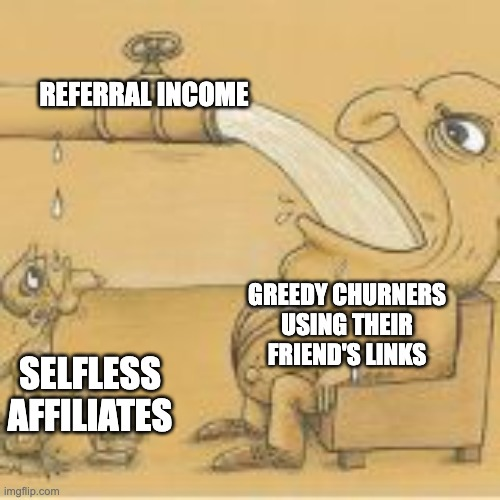
    And I don’t have an inherent problem with affiliate links. It turns out that maintaining a community is a lot of work, and I’m ok with creators earning referral income in return for their work. But that’s for original content that is helpful, not manufactured urgency. 

    Anyway, I’m sure the referral money is flowing as a result of the email so I’m the idiot here, but it still feels weird to see referral farming being done so shamelessly by a brand that I used to really trust for travel. Apparently you don’t even need to be purchased by Red Ventures to sell out these days. To me, this is such a human hobby centered on human interests of travel and financial independence and the commoditization of it is really lame. 

    So if you need to apply for a new card today, ask a friend for a referral link. Don’t have a churning friend? Go to a meetup. Buy someone a drink. Chat about what works for you and discover something new. All of that is going to get you way farther than shilling for the banks, and you don’t even have to lose your editorial freedom to do it. 

    Juejue!

    Pictured: some future affiliate bloggers discuss Fortnite the CSP


Sign up to be notified about new posts

Your email address will not be sold and will only be used to send you notifications about new blog posts – read our privacy policy for more info.

Archives