
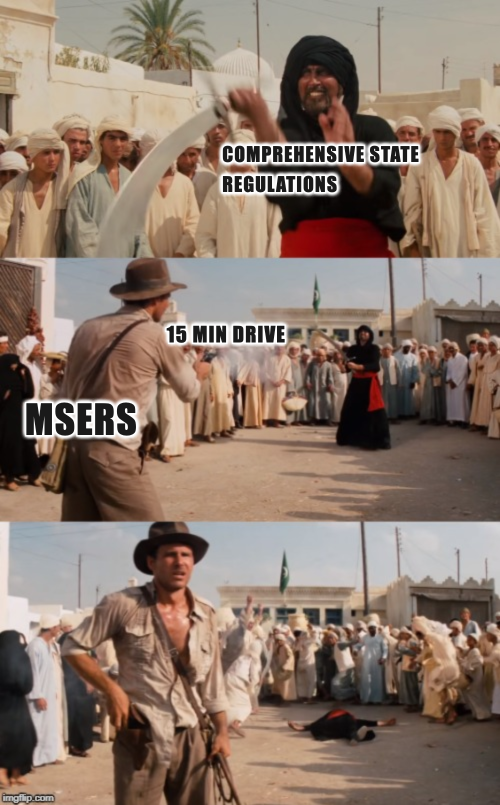
Pretty much everything we do as MSers boils down to arbitrage. While it may not necessarily follow the textbook definition that requires buying and selling an asset, it’s still a neverending pursuit of market inefficiencies.
There’s obvious examples – “pay” to earn points at a rate that is lower than the rate that you liquidate at. Move money in a way that earns you money, but costs you very little (or nothing at all).
The way I was taught arbitrage in international economics in college was all about arbitrage in the context of exploiting price differences in foreign markets – i.e. buying currency A, converting to currency B, which then can be converted to currency C and back to currency A at a rate that makes you money along the way. If you haven’t already listened, MEAB speaks to arbitrage and churning on an excellent episode of the Risk of Ruin podcast.
We have the term geoarbitrage now, which is a similar idea, but more based around the idea of earning an income associated with a VHCOL/HCOL area while living in an area that is very much not. It has existed for awhile, but really exploded with the popularity of digital nomading and the pandemic leading to remote workers temporarily leaving tech and finance hubs.
I’m not qualified to speak on that type of arbitrage, and you can go argue with other people about it in leanFIRE related spaces being that it is rather controversial.
Instead, this is more of a tongue-in-cheek post that resulted from a joking conversation I had with my friend mforch around the idea of “the best cities for MS”.
In no way am I suggesting you make lifestyle choices around MS. I’m just providing some breadcrumbs of what to look for when probing, and if you happen to be considering a change, maybe pull up that Kroger brand map?
Here are some of the factors in MS that can be affected by where you choose to live:
Government Policies
This one is multi-faceted and should be extremely obvious from the top. You aren’t playing this game all that profitably if you don’t have some type of connection to the US. Whether that means you live here, you have access to a P.O. box, ITIN, etc, these are essential. As I’ve covered before, for better or worse, exorbitant interchange is a uniquely American phenomenon.
It’s not just federal policy that affects the hobby though – there are plenty of government policies mandated at the state level that can affect you as well.
A decent chunk of the most profitable plays of the last several years all involved emerging markets that didn’t exist until relatively recently, and many states took different approaches to them.
Let’s take gambling for example. Sportsbetting recently became legal in the majority of states in the US, while online legals are only permitted in a handful of states. And of course, there’s our overseas friends operating “casinos”, and even they have different laws actively in motion in multiple state legislatures. It’s gotten so micromanaged that some states have different deposit limits than others on the same platform.
There was a direct relationship between how proactively (if at all) your state approved these new platforms and how much you stood to profit from them. This was actually a classic geoarbitrage play of leaving an area with little opportunity and visiting a place with ample chances to win.
Crypto is another good example. While there is more of a nationwide consensus on crypto, some states are actively excluded from the fun.
For example, New York’s BitLicense is extremely restrictive on new crypto businesses. When a shiny new one pops up on DoC ready to light millions of the Intercontinental Exchange’s money on fire, unlucky NYers (and Texans, in this case) aren’t able to join in.
Even very old school assets are not free from government legislation. Washington state recently passed a sales tax on gold purchases, while a similar bill is gaining steam in New York. These are important things to consider if these plays make up a big part of your portfolio, because a tax renders it useless overnight.
Businesses
On the flip side of the government factors we have corporations. As we all know by now, there are some stores operating in the same categories that are much more useful to MSers compared to their competitors.
For example, there is a family of 19 different grocery store brands that are coveted for making street MS more simple compared to other options. But they aren’t everywhere, unless you’re going to a roundtrip street MS commute the same day (and who knows someone crazy enough to do that?!)
There’s also warehouse stores to consider. Let’s say you were in on precious metals arbitrage – Costco is really the only store that matters because Walmart and Sam’s eat your margin (unless of course you wanted to throw in an overpriced ounce with your Common Project Achilles dupes on a certain retailer).
Some areas are blessed with high densities of good stores, making it feasible to make some very profitable runs, even with limited time in the day. While there are alternatives, the ceiling isn’t as high, and you can’t grab a glizzy while you’re there.
My last business example is banks and credit unions. While the vast majority of georestricted FIs have similar offerings and you can find the call to action this post was referring to fairly easily, there are a handful of true unicorns, and being in footprint makes it way easier (although this one comes down to luck, because unless you have a really good friend, you won’t know until you try).
People
While the first two were super obvious, this one is a little bit more subtle, but still matters, particularly for street MS.
Certain areas (especially cities, obviously) have high concentrations of MSers and optimizers, which means increased competition. It’s frustrating to wake up early before work to an empty Speedway rack or an Executive hour line all the way out to the parking lot on a good day.
The genie isn’t going back in the bottle on this hobby, so if you live in one of those areas, you need to realize you aren’t the only person playing the game.
Anecdotally, even the social norms of different areas can have an impact on your MS. I’m from an area where extended small talk with people you don’t know is normal. Whether you like this or not (I personally don’t), it can be helpful for getting through a large purchase or liquidation with the least amount of scrutiny possible.
Living in an area that is the complete opposite now, the awkward silence while the cashiers argue what the gift card limit threshold is makes a street run drag on and on.

Pictured: P2’s face while the cashiers are arguing over $500 and P1 is on the phone clearing a Citi fraud alert, because she was sold an actual grocery trip
Travel
Isn’t travel why we all started doing this in the first place? While we may have fallen head first down a rabbit hole of loops and insanity, most of us started because we wanted to travel for free.
Many of the challenges presented by the above three factors can be relieved very quickly if you’re a quick flight, train or drive away from an area where these aren’t present. I’m not able to take advantage of 100% of the opportunities that come my way, but I generally am if I travel a short bit from my home.
Additionally, most of the areas facing the challenges mentioned here are also extremely well connected to the entire US and 5 other continents.
Is perpetual easy gift card liquidation worth a long travel day to visit anywhere that isn’t a hub? Does being able to be worldly and fly direct to Tashkent offset that you can’t be worldly and play on casinos based in Estonia?
I have no idea, and like I said, this was more tongue-in-cheek than anything else. There’s a myriad of non-MS related factors that go into where you decide to live.
But in the original spirit of geoarbitrage, there are differences in MS income opportunities depending on where you live. And regardless of where you live now or in the future, understanding the different policies can be really helpful in spotting good opportunities that you are eligible for.
Tl;dr: live where you want to be, based on where you want to be – and if that happens to be a somewhat restrictive area, make sure you have a good VPN (and maybe aren’t too far from a state border).
Rahmat!
p.s. everyone knows the best city for MS is Lubbock, TX