
When I was a kid, my brother and I loved going to Disney World. My parents, being the saints they are, spent hours and hours planning each trip so we could see as much as possible while keeping things vaguely affordable (which was still somewhat possible back then).
My mom always sent me threads on Disney forums discussing rides, shows and restaurants to get me involved in the planning. I remember always asking my mom what “my DH”, “my DW”, “my DS”, and “my DD” were.
It was just Disney forum shorthand for family members – “darling husband/wife/son/daughter/etc.” but I remember being confused why they had a hobby-specific nickname, like they weren’t normal people.
Ironically, the people referred to by the acronyms in the hobby are the normal people, most of us would argue. It turns out that there’s something about really intense hobbies and strange ways of referring to your willing, but confused companions.
I don’t know where the video game-esque nomenclature around players came from, and maybe it was before my time. All I know is this – whatever you want to call your additional players, they’re essential to graduate beyond side hustle territory. And I’m not sure we’re always giving them their flowers.
Based on some common things I’ve heard from my P2 and conversations with some of my friends, I wanted to touch on things that we sometimes gloss over, but shouldn’t.
What do you mean I did this wrong? How was I supposed to know that?
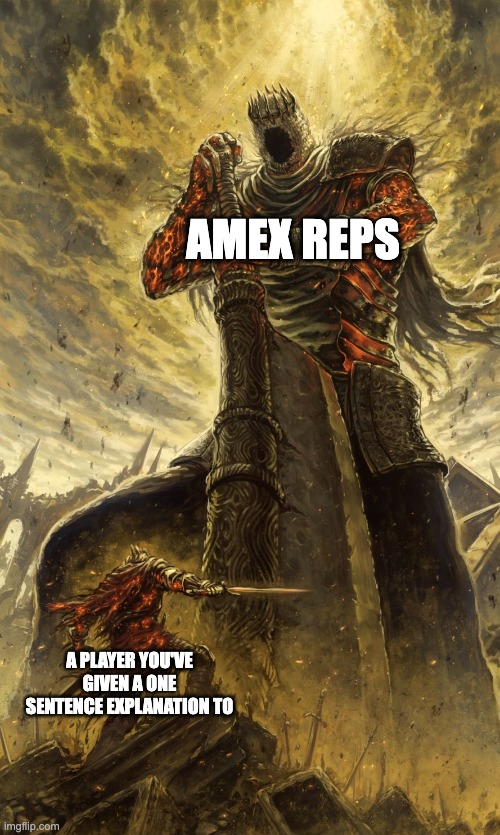
One common churner commiseration is their P2 doing something wrong during the process of a play. From saying the wrong thing on recon to using (or closing) the wrong card, there’s a myriad of ways that a play can go sideways.
I think it’s common for us to sigh and think to ourselves that they weren’t listening to our instructions. But I also think that’s kind of an oblivious opinion to have.
We’re all desensitized to huge numbers and to weaving a narrative about needing to “use your platform for rapid capital consolidation to aid in asset acquisition,” but no matter how much you talk about this stuff, your players aren’t.
There’s a reason why many veteran MSers have a desk that looks like the bike of the Taiwanese guy that really likes playing Pokemon Go. At a certain point, it makes sense to acknowledge that this is your hobby, and it’s your responsibility to make it as frictionless as possible for your players to participate in it. You’ll both be better off for it.

Pictured: a whale who definitely doesn’t have any issues with players making a mistake
The other day, I was talking to my P2 about how the year in churning had been going so far. I try not to get into the weeds too deep because most people don’t find the minutiae all that interesting (and I can’t say I blame them). She mentioned that it’s obvious why people want to churn and MS – money and free travel is great.
But she also noted that there’s something hardwired in those of us who are heavily involved that seems to enjoy how complicated and detail-oriented it is. And that ultimately, that’s why it’s not for everyone. I think that’s a true statement.
Our money is all over the place, and I have no idea how to unravel it
This is probably the most common critique of serious involvement in the hobby, and is extremely valid. It’s also tricky to address as a MSer, because a “here’s where our money is” spreadsheet becomes obsolete weekly, especially in 2026. The banks and fintechs I have at the top of the list of where to look change constantly as limits, cashback rates and shutdowns ebb and flow.
There’s certainly ways to make this process a bit easier, but there are tradeoffs. For example, you could stick to one MS friendly institution for your loop spending. That makes it easy to look at all of the account debits to see where the money is hiding.
But if you’re reading this, you’re likely holding at least three accounts that fit this bill, and possibly a handful more. As discussed last week, different banks care about different things, and their partners pay out differently. Simplicity does mean cutting out potentially significant profits.
I’m lucky to have people in the community I consider true friends that I know would be able to help P2 out in a worst case scenario, but that doesn’t mean I’m not trying to keep the spreadsheet as up to date as possible. An unexpected event is already stressful enough as is. My P2 has been very explicit that this is a worry of hers, and discounting it isn’t fair.
I wouldn’t even know where to start planning these trips
Once you move past the churner coming of age trips like overwater bungalows in the Maldives and the Japanese Park Hyatt trifecta, you’ll quickly realize you have the ability to take virtually any trip you can imagine.
When you can go beyond the standard Instagram destinations and onto remote adventures that are difficult to make work without points and miles, it’s natural to want your P2 to join in on the planning. After all, they’re going on the trip too, why wouldn’t they want to have a say in it?
My P2 generally doesn’t want to be super involved. For a long time, that confused me. She loves to travel just as much as I do, so it wasn’t like there was no interest in travel itself.
What my P2 told me made a lot of sense – I spend a lot of time chatting with y’all about the amazing places we all visit because of this hobby. It’s really easy to add new places to the bucket list when you have trip inspiration around at all times.
The other thing she mentioned was more specific to us, but maybe something that rings true for others. My P2 has an extremely demanding W2 in a notoriously toxic industry, while I’m lucky to have one that respects work/life balance and gives me the time and space to daydream about where to travel next.
She told me there’s a comfort and excitement that comes with knowing I’m handling the planning of two or three week trips that are often so remote that it’s impossible not to unplug. She doesn’t have the time and energy to do that, but I do.
tl;dr
Anyway, the tl;dr of this post is that a lot of us aren’t giving our extra players the credit they deserve. It’s easy to enjoy the spoils, but it’s not like they aren’t contributing. Like I said, it’s really hard to scale without willing and able shenanigans partners. And they’ll even listen and hit you with a “wooow that’s craaaaazy” when you talk about getting shutdown by a Snoop Dogg themed sweep.
As much fun as it would be, the goal isn’t to convert your P2 into a full time degen like you. It’s just to make their role as a P2 as simple as possible while acknowledging what their presence allows you to do. So next time you’re able to 2x (or many many x, depending on your ability to recruit) your latest play, don’t forget to show some appreciation to those who make it possible.
My P2 likes her appreciation shown via latte.
Kippis!
One response to “A soliloquy for P2s”
This week I heard a terrific barb I have placed into my quiver for future use:
“I can explain it to you, but I can’t understand it for you.”
Isn’t it great?
Well, it’s great for sounding clever but not great if you want to actually be understood. I spent many years writing contracts and there (as in life) if your audience doesn’t understand what you’ve communicated then it doesn’t matter who you think is culpable: it’s your problem.
A legal writing professor advised: when given an assignment, ask who the audience is. A memo intended to be read by a client should be written differently from one to be read by an attorney. I took that advice to heart and got many compliments (but zero job offers) for practicing it at my summer clerkships.
If you communicate to a civilian the way you’d communicate to someone in the hobby the shortcoming is entirely yours for failing to provide the correct context. The correct context doesn’t mean the most context (so feel free to ignore this multi-paragraph screed).
The challenge and joy in all communication, at least for me, is finding the balance between beauty, brevity, and accuracy. When I get it wrong, my gut reaction is to blame others and it takes real work to pause and think about how I can do better.
In my work, when a user asks a question I believe I’ve already answered, I re-read our user guide every single time. No one has read it more than me. In so doing, I afford myself the luxury of failing in private. When something isn’t explained as well as I’d hoped (or at all..) I get to fix it and provide my sincere apologies to my reader, thanking them for the opportunity to do better.
Just as that tome gets a little bit less wrong each day, I try (and sometimes fail) to extend that same gratitude to my wife (who is certainly worth more to me than the user guide any everyone who reads it). Growth comes not from blaming others or even from tolerating their mistake. It comes from what you describe: from appreciating one’s audience for giving one the gift of being less wrong.