
Will’s guest post last week got me thinking about my own churning and MS origin story and how that shaped my approach. This is an extended version of a story I shared at the MEAB meetup in June, so apologies if it sounds a little familiar to some of you!
The origin story
Somewhere in between the organized chaos of Usenet servers and early P2P clients that the uncs and old heads are familiar with and the shiny “may as well be Netflix and Hulu and Spotify combined” interface of a fully loaded Plex server that we have now, we had private torrent trackers. Private trackers were a welcome respite from the relatively unmoderated high seas experienced on the big trackers back in the day like The Pirate Bay, ExtraTorrents and Torrentz.
I’m getting nostalgic just typing this, thinking about how much time I spent as a teenager and young adult building a reputation to get invites to niche trackers like Kraytracker, Brokenstones and PunkTorrents. Being chronically online before that was a term shaped my musical tastes and developed the skills that turned into both my career and my MS skillset.
As great as all of those private sites were, there was an undisputed holy grail private tracker for people that were really into music: what.cd. Born in 2007 the same day that spiritual predecessor Oink’s Pink Palace was shutdown, what.cd was a cornucopia for music fans. Beyond that, it functioned as a lively community full of banter and a strong competitor to last.fm.
The major reason that an invite to what.cd was such a hot ticket was the barrier to entry. Signups didn’t periodically open like they did on so many trackers like that back then – you were required to take a fairly comprehensive interview on audio formats, spectral analysis, general torrenting and more. I read the official interview prep guide front to back, and eventually gained entry.
The site essentially looked like a better version of the iTunes music store at the time, where you could search by artist and find every single version of every single song they’d ever released. Plenty of artists even openly uploaded their content, knowing that the potential new exposure was worth any loss in digital download proceeds.

Pictured: An example of the thoroughness of a what.cd album listing – every release, in every format.
The only reason that the site was such a utopia was self-moderation derived from strict adherence to a minimum download to upload ratio – essentially, that you were sharing as much as you took.
While that was easy to do on a “private tracker” like Demonoid as you just had to leave your PC on, that didn’t cut it on what.cd. A balance credit on upload to download ratio was extremely valuable, so competition to earn it was fierce.
Smart folks rented “seedboxes” aka remote servers to ensure that they were the chosen seed when a new person downloaded a torrent. I was a kid when I got into what.cd, so that wasn’t feasible for me.
However, I was able to keep my account in good standing and well above the minimum ratio for quite awhile until what.cd’s untimely demise in 2016. Why? One of the most fun parts of what.cd was the bounty system – users with a surplus of upload credit could offer it as a bounty in return for a file that wasn’t on the site already (although this situation was few and far between).
This bounty system probably led to the eventual seizure of the site due to certain high profile bounties that were fulfilled like law enforcement tools and unpublished J.D. Salinger manuscripts, but it was also what kept me alive. For some reason, a true audiophile wanted a FLAC lossless version ripped from a fairly obscure album that I had already preordered because I had found the band on one of those other niche trackers.
I probably checked the tracking on that CD 1000 times in the week it took to get there, terrified that my best shot as a kid of building upload credit would be gone before it got there. Thankfully, I was probably one of only a handful of people that preordered that album, so I secured the bounty that tided me over for the next 7 or so years.
The MS application
Now, what does any of this longwinded story have to do with MS and churning? I’d wager quite a bit. It’s easy to draw parallels between the “high stakes” world of 2000s/2010s torrent trackers and the private spaces where MS knowledge is now shared.
Regarding barriers to entry, most of the valuable places to openly discuss the game aren’t exactly open to new people anymore. Whether that is a public advertised place like a private group associated with a blog or podcast or something unlisted like a like-minded probe group, you aren’t going to be able to find exactly what you’re looking for with zero effort like you could with the Pirate Bay or Demonoid back in the day.
It’s even easier to tie the upload to download ratio idea to MS. This game operates exclusively on reputation and trust – people are much more likely to share sensitive things with you when you can show you’ve brought original ideas to the table yourself.
One thing I hear often from beginner and intermediate MSers is that it can be intimidating to share something in a group or room with people that are more advanced than you. I understand that feeling (and it’s why I’m such a big proponent of finding a probe group at your level to grow together).
But in the spirit of my own story – sometimes you don’t need an expensive seedbox or an extensive collection of music to share something that is extremely valuable to someone. Even the biggest whales can’t check under every stone.
Whether that means probing a credit union, uncovering an esoteric quirk in an award travel program, or something else, don’t assume you don’t have something valuable to share. And if all else fails, do the MS equivalent of the what.cd interview prep guide – read as much as possible to understand as much as you can before asking questions.
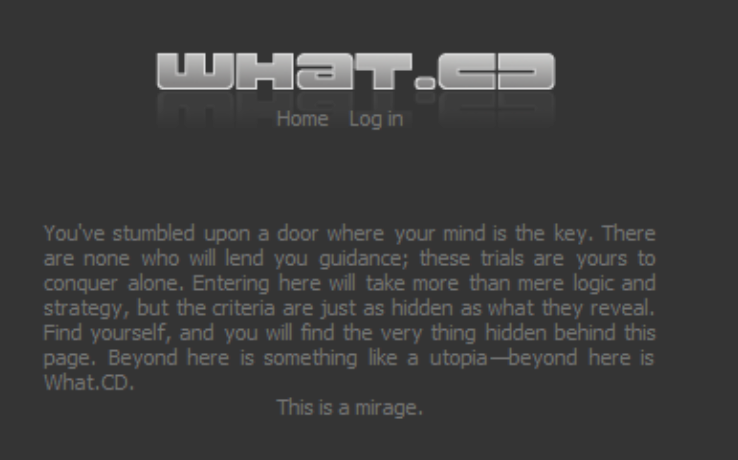
I’ll leave you with the quote on the homepage of virtually every torrent tracker built using Gazelle, a framework originally built by the what.cd team:
You’ve stumbled upon a door where your mind is the key. There are none who will lend you guidance; these trials are yours to conquer alone. Entering here will take more than mere logic and strategy, but the criteria are just as hidden as what they reveal. Find yourself, and you will find the very thing hidden behind this page. Beyond here is something like a utopia.
This is a mirage.
Dzięki!
3 responses to “An origin story, and thoughts on giving vs taking”
Wow this is a blast from the past. OiNK and What.cd were truly special communities. Never thought I’d see someone draw a connection between this and MS lol.
Haha they truly were! And drawing weird connections like that is exactly what this blog is for, for better or worse.
Loved reading this. Similar path for me. I wasn’t in the music scene but other adjacent ones on Usenet, FTP and P2P platforms of the day.