
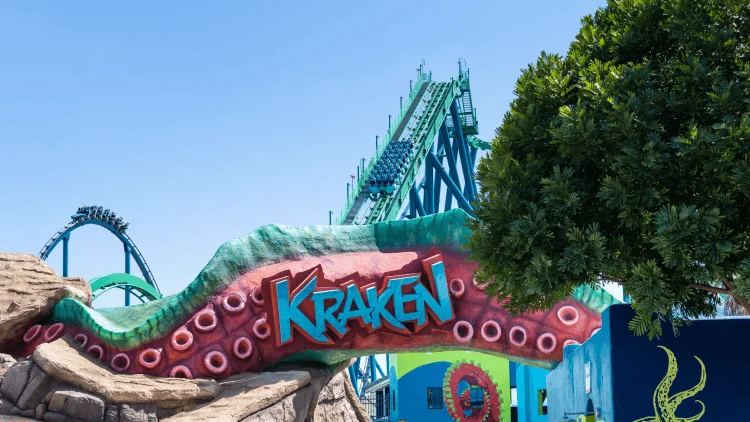
There’s a handful of types of multi inversion elements in the roller coaster world, and my favorite has always been the cobra roll. The cobra roll is a double inversion (aka double loop) and is one of the signature elements of the legendary run of 90s and 00s Bolliger & Mabillard coasters (including my childhood GOAT Kraken)
This post doesn’t really have anything to do with roller coasters outside of a loop metaphor, but I wanted to give a shout out to some of my good churning friends that are coaster enthusiasts. This hobby could really use more events at Cedar Point and less at small convention hotels in the middle of boring suburbs, but I digress.
Loops have been a common discussion topic on the blog because they’re a major part of more advanced MS. And as we discussed, sometimes a loop isn’t really a loop at all and is instead a set of (hopefully profitable) discrete squiggles.
The standard rationale for allocating your float to the loops you’re aware of is the good ‘ol weighing of the relationship between margin, velocity and risk. If you’re happy with the end output from your napkin math and you’re avoiding a particularly low-margin Moment, it generally makes sense to run.
Most of the time, the final figure convincing you whether to run the play or not is a profit number. While that number matters, let’s not forget about the inverse of the separate loop scenario. The opportunity cost of using money to do one thing vs. another is very important. But in certain pockets of fun, it’s more of a bizarro world ‘opportunity benefit’ instead.
I’ll cite the MEAB post I cite more than any other as the underlying math for this since I had to be saved by the curve in calculus, but this concept is pretty simple. More velocity means more profit, as long as it doesn’t cause you to get shutdown.
But the fact that these loops are really separate squiggles can be useful beyond just framing your opportunity cost – sometimes, one seemingly meh component creates an arbitrage opportunity elsewhere.
I’m explaining this in a nebulous way, so let me give a probably-just-as-nebulous example.
Let’s say you had a platform that allowed you to spend a set amount per day, albeit with a fee. There were ways to come out ahead of the fee, but they were either extremely low margin, extremely obscure, or both.
But said platform also takes different payment options than some of your other usual suspects, and this allows you to utilize float you can’t use in other places. That changes the equation, but not in a glaringly obvious way.
Purely for illustration, let’s say you were generally able to squeeze something like $25-$50 per $10k you ran through this platform using this payment method. Not exactly worth the time, especially if, like me, you aren’t as smart as you think you are and variance gobbles up all of the paltry margin. Sure, you get another currency too, but we all have a bazillion of those and can’t offload them.
The peanuts you’d earn if you get lucky aren’t exciting, and neither are the powdered eggs you’d get to eat from the other side of the equation. The real boon lies in the ability to increase your velocity elsewhere.
Since most people aren’t just moving money around willy nilly, banks don’t really like to see that. But if you’re using all of the platforms and products in the “loop” in the way they intended, it’s a lot easier to look like a normal customer, albeit a bit of a degenerate.
Anyway, the end result of this is that you moved float into a format that is more usable for other loops, a coin toss on whether you earned anything, and a handful of a walled garden currency. The former is the exciting one here, and the rest is just the cherry on top.
While this is a specific example, there are many ways to use this general idea to increase your opportunities to arb. Good luck on the probing.
Gëzuar!

Pictured: this blog post, in meme form